
Why the Future of 3D Generative AI is Programmatic
Discover how programmatic 3D generative AI reshapes workflows by producing editable, script-based assets instead of static meshes.
Read Article →
3D generative AI uses deep learning models to automatically create three-dimensional assets — meshes, textures, and scenes — from text prompts, images, or other conditioning inputs, dramatically accelerating 3D content workflows.
Traditional 3D modelling requires manual work in tools like Blender or Maya. 3D generative AI replaces or augments that process: a model takes a conditioning input (an image, a text description, a partial shape) and outputs a usable 3D asset.
State-of-the-art systems like Trellis use structured latent representations — such as Sparse Latent Transformers over voxel grids — combined with diffusion processes to generate geometry and appearance jointly. The output can be extracted as meshes, Gaussian splats, or radiance fields depending on the downstream application.
Key challenges include topological correctness (watertight, manifold meshes), controllability (respecting dimensional constraints), and production-readiness (clean UVs, sensible polygon counts). Programmatic approaches that output editable scripts rather than static geometry are emerging as a way to maintain editability.
Datameister operates at the frontier of 3D generative AI, from fine-tuning foundation models to building constraint-aware generation pipelines for industrial design.
Discover how programmatic 3D generative AI reshapes workflows by producing editable, script-based assets instead of static meshes.
Read Article →
Practical lessons from finetuning Trellis for image-conditioned 3D generation, covering data quality, memory bottlenecks, and overfitting.
Read Article →
Learn how Trellis 2 uses native 3D Omni-Voxels and efficient latent compression to enable scalable and physically grounded 3D generation.
Read Article →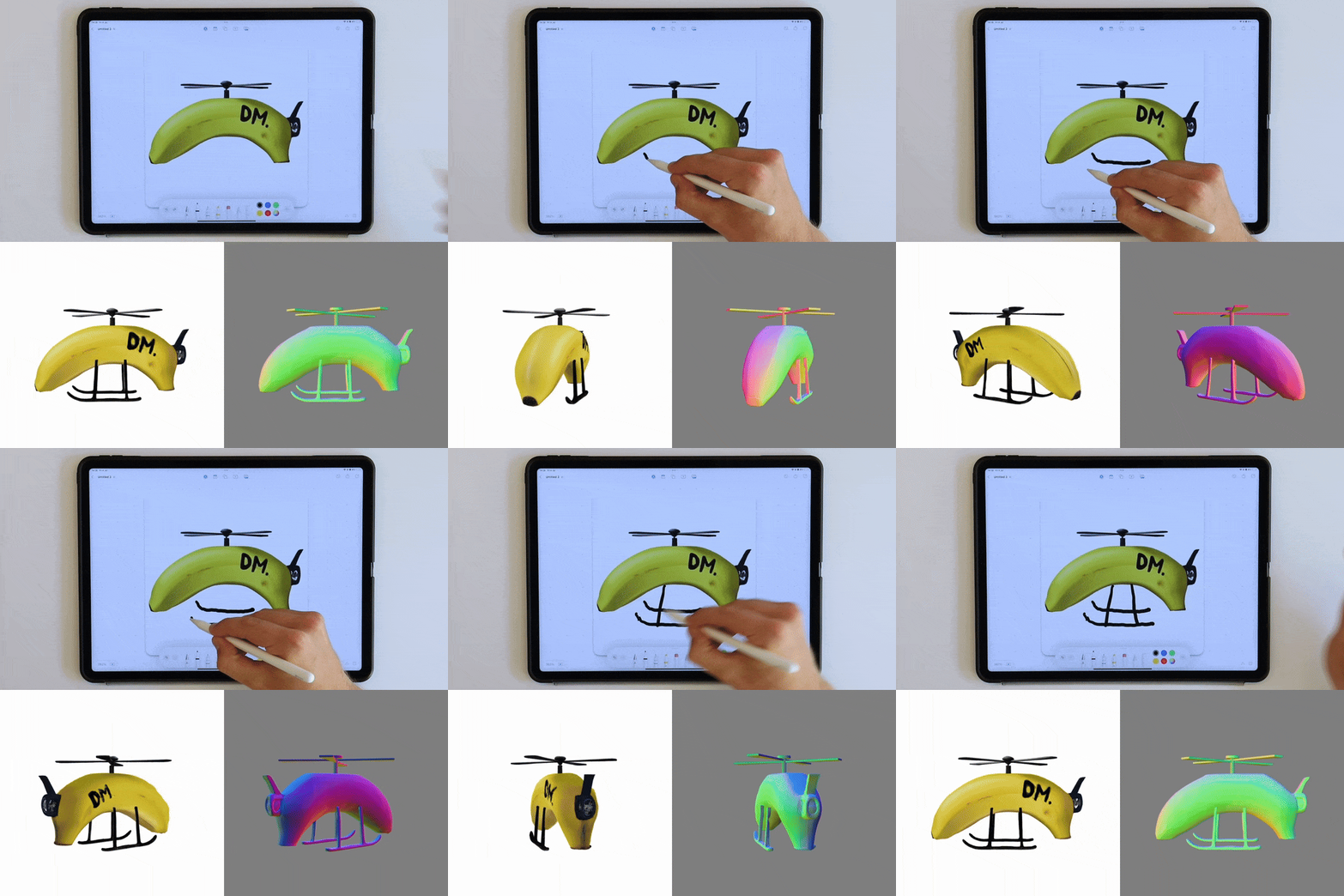
Constraint-aware 3D generation for industrial design: explore creative variations while hard points stay fixed. Trellis diffusion + masked gen + differentiable rendering for buildable assets.
Read Article →
Explore Trellis, Microsoft’s open-source leap in 3D generation, and discover how it compares to cutting-edge tools like Rodin, Tripo, SPAR3D, and Hunyuan3D-2. Dive into the evolution from NeRFs to advanced voxel-based pipelines, uncover essential concepts in image-to-3D modeling, and learn why Trellis is a turning point for creatives and developers alike. Datameister’s expertise bridges research with real-world impact, delivering next-level 3D generative solutions.
Read Article →